
How to Get Executive Buy-In for Proposal Management Software
If you work in B2B sales today, you don’t need anyone to tell you the landscape has changed. Buyers are cautious. Committees are bigger. CFOs expect financial proof, not hopeful promises. Deals that once felt straightforward now require a far stronger value story to stay alive.
This is where Value Management comes in, enabling teams to move beyond feature talk to outcome-driven conversations, create strong business cases, and position themselves as trusted advisors instead of hopeful vendors.
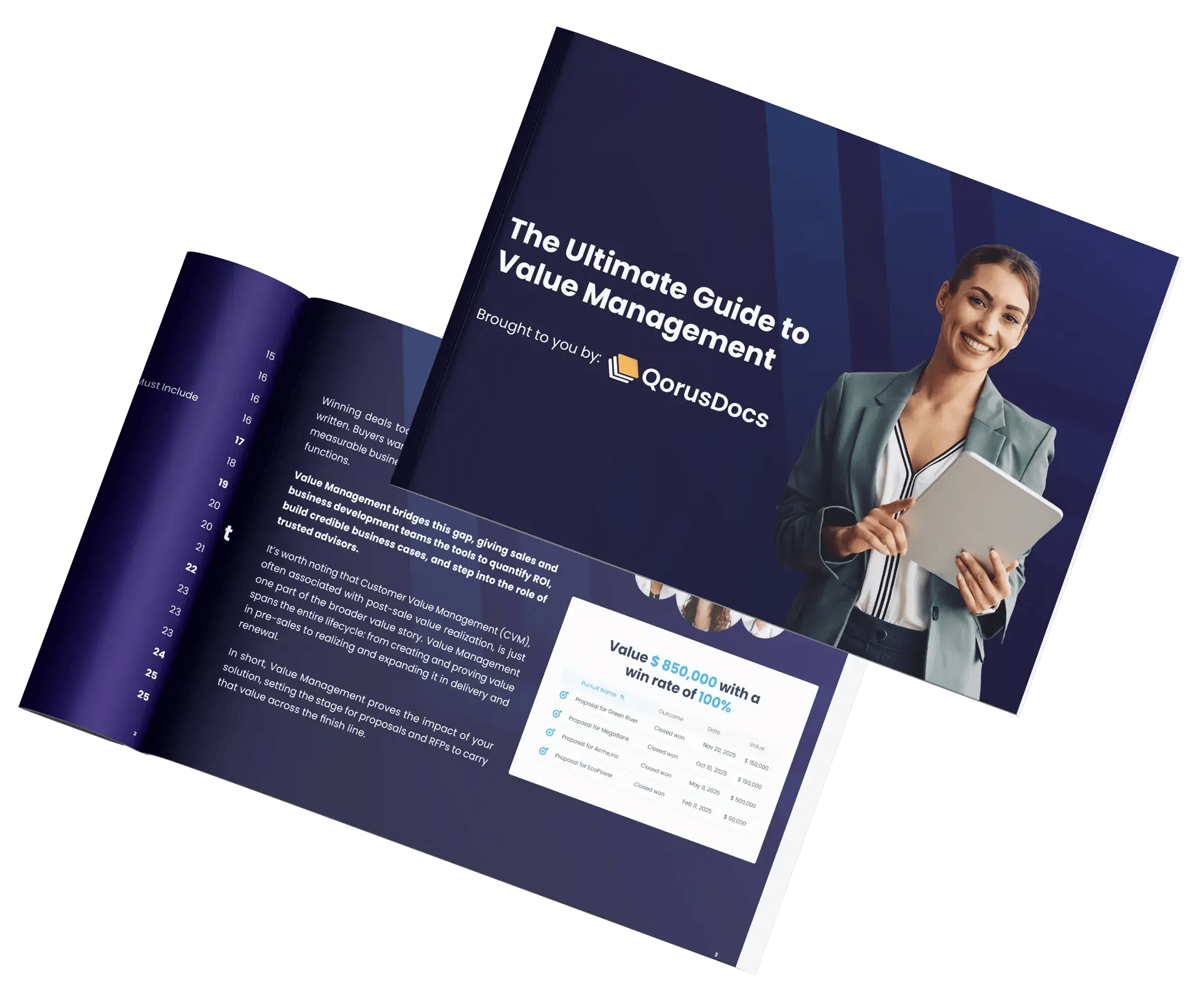
Our new guide, The Ultimate Guide to Value Management, breaks down this shift in detail. Let’s dig into some of the topics it covers.
Why Value Management Matters
Buyers want confidence based on numbers that make sense. When you can show how your solution affects cost, risk, productivity, or growth, deals move faster. When you can’t, they stall.
Value Management brings structure to these conversations. It creates a shared language around outcomes and makes it easier for buyers to see you as a partner who understands their goals. That shift, small as it seems, is often what wins a deal.
The Value Gap
Many strong solutions fall short because the business case lacks clarity. The culprit is often an improvised spreadsheet that no one fully trusts. Hidden formulas, mismatched versions, and heroic assumptions don’t inspire confidence.
And spreadsheets simply don’t scale. As deals grow more complex, teams need consistency, transparency, and a process that holds up under scrutiny.
Value Management closes this gap by replacing fragile models with a reliable, repeatable framework. It also saves everyone from the dreaded “Final_v7_REALLYFINALTHISTIME.xlsx” spreadsheet scavenger hunt, which, frankly, is a victory in itself.
Foundations of Value Management
Value in B2B is measurable. Clients want to know how your solution changes their financial reality, and Value Management helps you quantify and communicate that story.
It is also collaborative. Sales, presales, value engineers, and customer success all play a role in shaping and delivering the value narrative. When everyone aligns on the same story, the buying experience becomes more coherent and more credible.
Most importantly, value conversations should start early, not at the procurement stage. Once a competitor has defined the narrative, you are fighting an uphill battle.
Start the Value Conversation Early
Waiting until procurement asks for ROI justification is too late. By then, the client has already formed expectations, and the financial lens is set.
Introducing value during discovery helps you qualify opportunities faster, build trust sooner, and shape a narrative rooted in the client’s priorities. Early value framing also keeps the rest of the sales cycle grounded in outcomes, not guesswork.
What Makes a Business Case Credible
A strong business case is clear, realistic, and transparent. Buyers want to understand the assumptions, the timeline, and the financial impact without feeling like they need a decoder ring.
The Ultimate Guide to Value Management walks you through core financial measures like Payback Period, Net Present Value, and Internal Rate of Return. These metrics help you speak the language of finance and give decision makers what they need to justify the investment internally. When the business case is rigorous, buyers use it as a decision tool, not sales material.
Best Practices for Stronger Value Conversations
Our new guide outlines several practices that help teams build better value stories. Here are a few:
-
Make it collaborative. Co-create assumptions with your client. Shared ownership strengthens belief in the outcome.
-
Tailor to each stakeholder. A CFO, CIO, and end user care about very different things. Speak to what each group values most.
-
Anchor everything in real numbers. Specific, realistic data builds credibility. Generic claims do not.
A Look at the Road Ahead
The future of Value Management is being shaped by AI. Today, AI can help teams gather data, check assumptions, and draft early ROI models. Soon, specialized agents will go further. They will recommend proof points for specific buyer roles, test scenarios instantly, and surface insights from past cases to strengthen new ones.
This does not replace the human element. It elevates it. Sellers and value engineers will spend less time formatting numbers and more time connecting those numbers to strategy, risk, and long-term goals. That’s the part buyers care about most.
This Was Only a Glimpse
The Ultimate Guide to Value Management goes deeper into the lifecycle, the structure of a bulletproof business case, common mistakes, a buyer’s guide to value management software, and the growing role of AI in business case development and proposal management software.
If your goal is to win more deals, shorten sales cycles, and build stronger relationships with buying committees, this guide offers a clear path forward.
Ready to dive in?
Download The Ultimate Guide to Value Management and start building value stories that win trust and close deals.