

How Law Firms Can Use AI in Business Development Without Losing Control
For law firms, repeat business has obvious financial value. Winning more work from existing clients protects and grows an important revenue stream, while each new pitch is also a chance to show how well the firm understands the client and reinforce why the relationship should continue.
Yet, these pitches are never a done deal. In theory, the pre-existing relationship, relevant experience and people inside the firm who know the client should make the process easier. However, that isn’t always the case.
Repeat Business Depends on What the Firm Can Reuse
Having the knowledge and being able to use it are two different things. Experience may sit in one system, approved proposal content in another, and useful client insight somewhere else.
A partner may remember the perfect matter but not enough detail for the proposal team to find it easily. The strongest version of a case study may be inside an old pitch rather than the firm’s content library. Then another opportunity comes along, and someone has to find or recreate the same material again. And when several pitches are moving at once, that repetitive work adds up quickly.
This is where the legal proposal management process can become unnecessarily time-consuming. Without a doubt, firms get more value from what they already know when that knowledge is easy to find and use. For legal teams, putting the firm’s existing knowledge to better use can reduce wasted time, improve the chances of winning the work and strengthen the client relationship along the way.
Live Pitches: Stress Test + Opportunity
A live pursuit puts firm content under a different kind of pressure. Standard material may be accurate and approved, but once it has to support a specific client story, weaknesses become obvious. The team may add context, sharpen the language or rethink which proof points are actually useful. In the process, the pitch often produces better content than the firm started with.
What our legal account team often sees when first talking to new clients is that many law firms have a much clearer process for taking content out of a library than they do for putting better content back into it.
If an updated bio, case study or matter description remains inside the final submission, the next team may never know it exists. Over time, the formal content library and the material people are actually using can drift apart.
The Law Firm Pitch Process Should Work as a Loop
A stronger proposal workflow closes that gap. When a useful piece of content improves during a pursuit, there should be a way to flag it for review. If the change is worth keeping, it can be approved and returned to the firm’s content so other teams can use it.
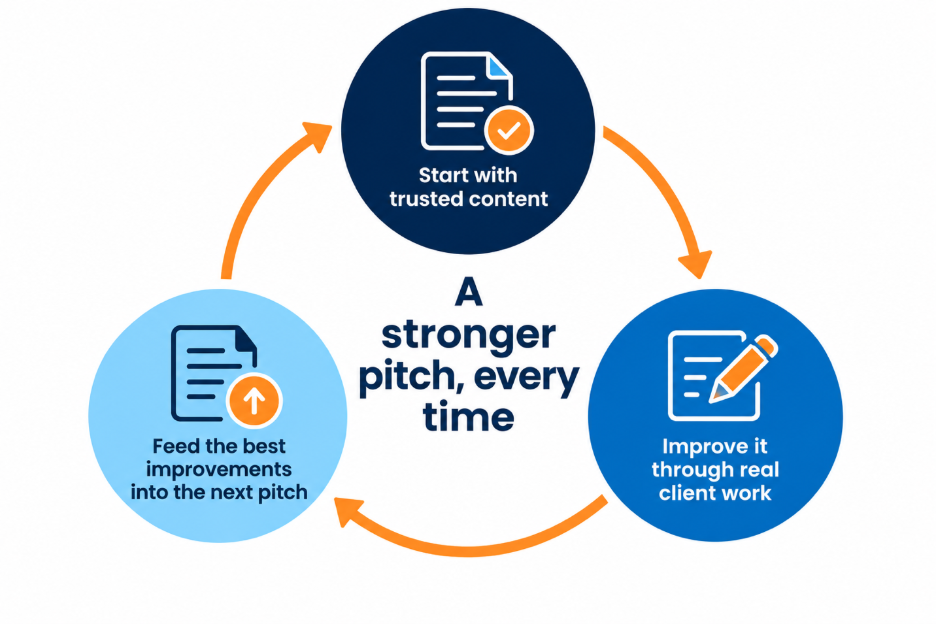
The benefit is not limited to the proposal team. Partners and practice groups across the firm are more likely to be using the same current material when they go in front of clients. That helps the firm tell a more consistent story about its experience and capabilities, regardless of who is creating the pitch.
For an existing client, consistency has particular value. The firm shouldn’t appear to have forgotten what it already knows about the relationship simply because a different team or practice group is handling the next opportunity.
Proposal Content Management Becomes More Important With AI
AI is already becoming part of legal proposal management. Teams are using AI for research, summaries, RFP responses and first drafts. Our research has found that 43% of respondents are already using AI across 25% to 49% of their proposal workflow. Only 2% report using it across the entire process.
For law firms, one of the practical questions is what the AI is actually working from. If it has access to current, approved and relevant material, AI can help a legal proposal team use that knowledge much faster. If the underlying content is scattered or difficult to verify, the team still has to work out what can safely be used.
This is why AI for legal proposals does not make content governance less important. It puts MORE of a burden on firms to know what is current, who owns it and whether it has been approved.
How to Pinpoint the Content Breakdowns
Law firms tend to measure proposal performance around the individual opportunity: turnaround time, workload, win rates and volume. Those measures are useful. But firms looking to improve repeat business should also look at what happens between pitches.
5 Questions to Reveal Process Problems
- Did the last pursuit leave the firm with better content?
- Was new experience captured somewhere useful?
- If a partner improved a biography, can another team find that version?
- When a client comes back with another opportunity, can the team quickly find the experience most relevant to that relationship?
- Or does every new request trigger another search through old pitches, inboxes and individual memories?
Building a Pitch Process for Repeat Business
For firms that rely heavily on existing clients, the real advantage comes from carrying what the team learns from one pursuit into the next. Better matter descriptions, newly surfaced experience and stronger client-specific content shouldn’t have to be rediscovered every time the client comes back.
That thinking is at the heart of The Connected Pitch: How Law Firms Are Winning More Repeat Business. The guide looks at how law firms are connecting experience data, governed content and AI-assisted proposal workflows, where the process tends to break down, and what firms can do to make each pursuit build on the last.
Download The Connected Pitch to see how leading law firms are using a more connected pitch process to strengthen existing-client relationships and compete for the next piece of work.