
Proposal Management Knowledge Capture: When Expertise Walks Out the Door
When QorusDocs began introducing AI agents for proposal management to customers, the enthusiasm was there. Proposal teams could see the potential. But incorporating individual agents into their everyday workflows proved more difficult than expected. With bids and pitches already filling their days, teams had little time to figure out how to make the new technology part of their process.
That experience helped shape QPilot Workspace, which brings people, AI agents, and industry-specific intelligence together around the pursuit itself.
We asked QorusDocs CEO, Ray Meiring, what the company learned from its early adopters, how Workspace changes the way proposal teams work, and where he sees human-agent collaboration heading next.
Q: QorusDocs has been introducing AI agents for some time. What made you decide to bring them together in QPilot Workspace?
Ray: What we clearly saw in early access is that a better way for agents and humans to collaborate is required. The appetite for agents was real, but when we asked customers to take agents one at a time and assemble them into a working process, on top of a full workload of live bids and pitches, it was too much.
People were excited about what an agent could do, and then the practical questions piled up. Which agent do I use for this step? What do I ask it? Who reviews the output? How does that fit into the way we already run a bid?
Each of those is a small decision, but none of them is the day job. The day job is a response due on Friday. A team can't stop running pursuits to design a new way of running pursuits.
So, we stopped trickling out individual agents and brought everything together into one environment where people and agents work together across the whole pursuit. People bring the authenticity, creativity and judgment, and the agents do the time-consuming work. They also come with the process around them: what happens at each stage, who does what, and what good looks like.
Q: What does that collaboration look like when a team is responding to an RFP?
Ray: Think of a team running an RFP. The pursuit gets created, and that can even happen from a conversation in Copilot or Claude. Agents then pick up the assignments: researching the client, pulling the best-fit credentials, finding the clarification questions in the RFP, drafting answers from the firm's approved content with sources, and assembling the documents in Word or PowerPoint.
That is where people step in. A person reviews, refines, and approves the work. Sometimes that even means writing a section by hand. The pursuit lead stays in charge and is no longer starting every section from a blank page.
Q: Why have you organized QPilot Workspace around the pursuit itself, rather than around AI chat or content search?
Ray: Because the pursuit is where the work, and the value, actually lives. A search is a moment, and a chat is a moment, but a pursuit has a deadline, a team, a process, a set of deliverables and an outcome. When you organize the experience around the pursuit, search, content, agents and chat all become things that serve that outcome instead of competing for attention.
What we care about is driving better outcomes for our customers, and for a professional services firm that means winning more work and increasing revenue. Pursuits are how that work is won, so the pursuit is the center point.
Q: QPilot Workspace can be accessed through tools such as Copilot and Claude. Why was that important?
Ray: Because agents need to fit into our lives, not the other way around. People have become familiar with their software, and it is where they have chosen to work. Many of our customers live in Microsoft 365, and Copilot is where a lot of them will start, while others prefer ChatGPT or Claude. Our job is to bring live pursuit data, approved content and the ability to act into the tool they already chose, rather than asking them to copy things between systems.
Everything is an entry point into the same pursuit. You might create a pursuit from Copilot, continue it in QPilot Workspace where agents and the team collaborate, and finish in Word or PowerPoint, where the deliverables live.
It also has to be safe: every request runs as the signed-in user, so existing permissions apply, and answers are grounded in the customer's approved content, with sources. Customers shouldn't have to choose between the AI tool they like and a system they can trust.
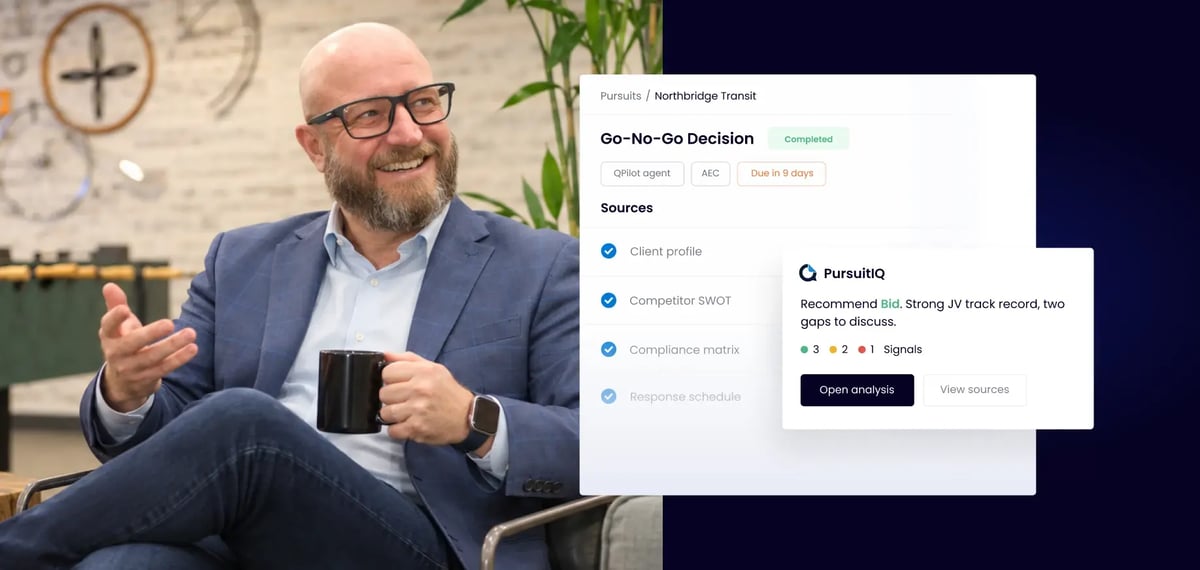
Q: PursuitIQ brings industry-specific knowledge and best practices into the pursuit process. How does that work within QPilot Workspace?
Ray: The agents are only part of the value. People don't have time to learn to write prompts, then test and refine them, so that has to come with the workspace.
PursuitIQ is the intelligence behind how people and AI agents work together in QorusDocs. It draws on industry best practices and a firm's own experience, content and pursuit history. The value comes from knowing how people and agents should collaborate around a particular outcome: the steps they take, how the agents behave and interact, and what documents are created.
That includes the process stages, assignments, prompts, templates and content structure required. It's knowledge we've built from real implementation experience across many customers.
The idea is that customers start from what works in their industry and then personalize it to their firm. The work is different from one industry to another, and so is what wins it.
In a law firm, much of the legal proposal management process revolves around people and reputation: lawyer bios, matter experience and credentials, partner preferences, capability statements, pitches, panels and directory submissions, and review by senior lawyers whose time is scarce.
An engineering firm is often responding to large, compliance-heavy RFPs with project experience, team resumes, standardized forms, teaming partners and a technical volume alongside pricing. The stages, the assignments and even the right prompts are different.
If you gave both the same generic workflow, you would be forcing one of them into a process that isn't theirs.
Q: With tools like ChatGPT and Copilot becoming more capable, why does a firm need something purpose-built for pursuits?
Ray: Generic assistants are very capable, and I’m glad about that, because we now show up inside Copilot and Claude. So, I don’t think the choice is generic AI versus QorusDocs. The real question is what sits behind the chat.
A general assistant doesn’t manage a workflow, and it is not a system of record. It doesn’t record each pursuit, its outcome and the nuances of data that went into it. QorusDocs does, and it consistently references and maintains the people records and firm experience that every pursuit draws on.
There is also a more basic problem: generic assistants are non-deterministic. In a production environment you need consistency, with the same workflows running the same way and the same templates, with the right branding, producing documents that look authentic, and AI filling in the gaps and adding productivity.
Other tools let you chat with content. QorusDocs lets you run the pursuit from the conversation, with sources and with each user’s permissions respected. That is what turns a clever answer into a repeatable result.
Q: How much should AI adapt to a firm's existing proposal process, and how much should firms be willing to change?
Ray: Both. AI should adapt to what is genuinely distinctive about a firm: its voice, its partner preferences, its approval rules, how it handles certain document types.
But firms should be willing to change what is accidental: hunting through long template lists, copying content between systems, chasing status by email.
Template selection is a good example. Instead of a person choosing from a long list on a create form, an agent can choose, guided by a prompt that encodes the logic a person would otherwise apply, such as the practice area, the partner preference and the type of document.
That's the AI adapting to the firm's logic, and the firm letting go of a manual step it never really valued.
Q: As AI agents become more autonomous, where do you think human judgment will become more important?
Ray: I expect agents to become far more autonomous, with much less manual intervention. They will take on a growing share of the work in a pursuit, including the research, gathering, first drafts, comparisons and assembly, and carry longer sequences of steps on their own.
I think human judgment becomes more important, not less, and it moves up the chain. Whether to pursue at all, what the client really cares about, how to position, what to promise, how to price, and whether this really sounds like us.
Authenticity, creativity, intuition, empathy, quality supervision and common sense are the things agents don't replace. And as agents produce more drafts, faster, the quality of the review matters more, because more could go out the door.
Agent-to-agent work will grow too, but trust will still come from human to human to agent: a client trusts the people on the other side of the table, and extends that trust to the agents working for them.
The firms that do this well will be the ones that decided deliberately where the human sits.
Q: What should proposal leaders be doing now to prepare for this more agentic way of working, even if they aren't ready to adopt it tomorrow?
Ray: Start with the foundations, which are valuable whether or not you adopt agents tomorrow. Get your pursuits into one place with a defined process: stages, owners, and what done looks like. Clean up and approve your content, so bios, experience and answers have a single source of truth and an owner. If the content is stale, an agent will simply use stale content faster.
Then pick one small, repeatable use case, such as capability statements or directory submissions, and learn on that. Decide in advance what a human must always review.
Get hands-on yourself, using the AI assistants in your daily work, so the new way of working feels normal before you ask your team to adopt it. And capture win and loss outcomes, because what you learn from them is what makes your process better over time.
See QPilot Workspace in Action
Explore how QorusDocs brings AI agents, industry-specific intelligence and your firm's approved content together to support people throughout the pursuit process. Book a demo to see QPilot Workspace in action.

Published by: Jennifer Tomlinson
October 29, 2026
October 29, 2026