
From AI Experiments to Everyday Work: QorusDocs CEO Ray Meiring on the Future of Pursuits
A year ago, I would have said the biggest challenge with AI agents would be convincing people to try them. I was wrong.
What we've found at QorusDocs is that the appetite for agents is real. People want to use them, and they're often impressed by what they can do. But during our early access program, we saw how difficult it was for proposal teams to make individual agents part of their everyday work.
The technology wasn't the bottleneck. It was the capacity to absorb it.
I think the market is underestimating what it takes to make AI agents useful beyond the initial experiment. It's one thing to demonstrate an agent that drafts a proposal answer. It's another to make that capability part of a team's established workflow, particularly when they're already managing live bids and deadlines.
A Successful AI Experiment Isn't the Same as a Working Process
Imagine you're managing a proposal that's due on Friday. You've got contributors to coordinate, experience and credentials to gather, content to review, and a client deadline that isn't moving.
A team might try an agent, get a good result, and then struggle to make it routine. People don't have time to design the workflow around it, or to learn to write, test and refine the prompts behind it. A team can't stop running pursuits to design a new way of running pursuits.
And there are practical questions to resolve. Which step should an agent own? What must a human review before anything goes out? Which template, with the right branding, does the result land in? How does the team change its habits while the normal workload keeps coming?
Someone has to answer those questions before an agent can become a reliable part of the process. Leaving every proposal team to work them out for themselves is asking a lot.
Plenty of organizations will find they've invested in AI but never really made it part of how they work.
We're Underestimating the Value of Knowing How Work Gets Done
There's a great deal of attention on what AI agents can do. Their capabilities are expanding quickly. What takes years to develop is the process, templates and industry best practices that tell you how to use them effectively.
Consider what goes into a successful proposal. There's the research, content gathering and drafting, of course. But there's also the experience of knowing which credentials will resonate with a particular client, when senior reviewers should get involved, and what makes a response compelling.
Some of that knowledge is documented. Much of it lives in the experience of people who have been doing this work for years. And the process varies considerably between industries and individual firms.
A law firm preparing a panel pitch may need lawyer bios, matter experience and partner approvals. An engineering firm responding to a compliance-heavy RFP may need project credentials, teaming partner information and a technical volume alongside pricing.
That's part of the thinking behind PursuitIQ the industry-specific intelligence we've built from real implementation experience across many customers. It helps guide how people and agents work together, drawing on established processes, templates and best practices rather than expecting every firm to work it out for itself.
AI Should Adapt to the Firm. But Firms Need to Change, Too
AI should adapt to what is genuinely distinctive about a firm: its voice, partner preferences, approval rules and how it handles certain document types. All the things worth preserving.
But firms should be willing to change what is accidental: hunting through long lists of templates, copying content between systems and chasing updates by email. Take template selection. Instead of someone choosing manually from a long list, an agent can make that choice based on the practice area, the partner's preferences and the type of document being produced. The firm's preferences still guide the decision, but the person no longer has to make that selection every time.
We should be looking at which steps need human judgment and which ones people are doing simply because that's how the work has always been organized.
As Agents Do More, Human Judgment Becomes More Valuable
I expect agents to become far more autonomous, with much less manual intervention. They'll take on a growing share of the work in a pursuit, including research, gathering information, first drafts, comparisons and document assembly. They'll also learn how the person giving instructions works, so people spend less time directing them and more time supervising outcomes.
I think human judgment becomes more important, not less, and it moves up the chain. People will still need to decide whether to pursue an opportunity, what the client really cares about, how to position the firm, what to promise and how to price. And they'll need to judge whether the finished proposal really sounds like them.
Authenticity, creativity, intuition, empathy and commonsense are things agents don't replace. And as agents produce more work, faster, the quality of human review matters more because more could go out the door.
Agent-to-agent work will grow too, but trust will still come from human to human to agent: a client trusts the people on the other side of the table and extends that trust to the agents working for them. The firms that do this well will be the ones that decide deliberately where the human sits.
Start Smaller Than You Think
Starting small is often the better approach. It's tempting to begin with the biggest RFP or the workflow that consumes the most time, but that also introduces more complexity and risk.
A capability statement or directory submission may be a better starting point. Choose something repeatable. Make sure the underlying content is accurate and approved. Decide what the agent will do, what a person must review, and what a successful result looks like. Then learn from it. Small, repeatable wins build the confidence to go further.
Proposal leaders can also begin preparing now by getting their pursuit processes into better shape, establishing ownership of content, and capturing the outcomes of completed bids. These are valuable improvements whether or not they're ready to adopt AI agents.
And get hands-on with the technology yourself. It's difficult to lead people through a change you haven't experienced.
Why We Built QPilot Workspace
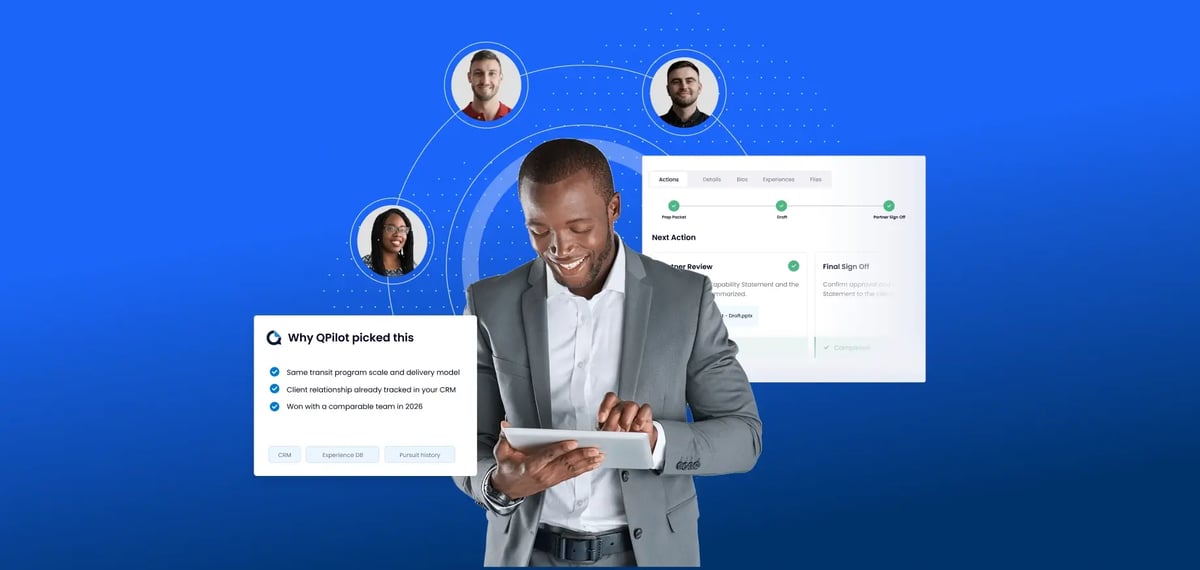
What we saw with our customers changed how we approached AI agents at QorusDocs. Rather than continuing to release individual agents and expecting teams to work out how to use them together, we brought them into one environment where people and agents collaborate throughout the pursuit.
QPilot Workspace brings agents, assignments and processes together, with industry-specific intelligence from PursuitIQ helping guide the work. A pursuit might begin in Copilot or Claude, continue in Workspace and finish in Word or PowerPoint, with people responsible for reviewing and approving the results.
We've learned that giving people access to AI agents isn't enough. We need to make it easier for them to use those agents in the work they're already doing.
See QPilot Workspace in Action
Explore how QorusDocs brings AI agents, industry-specific intelligence and your firm's approved content together to support people throughout the pursuit process. Book a demo to see Workspace in action.

Published by: Ray Meiring
November 3, 2026
November 3, 2026