

QorusDocs vs. Loopio: Which Proposal Management Platform Is Right for Your Team?
AI-native RFP response tools deserve credit. They have made one stubborn part of proposal work easier: getting to a usable first draft. And for the right team, that is a real win.
For law firms, AEC firms, technology services providers, and other professional services organizations answering structured questionnaires, security reviews, technical RFPs, RFIs, DDQs, or vendor assessments, the appeal is clear. These tools can search a knowledge base, suggest answers, summarize requirements, and help teams avoid the blank page. They are often lighter to set up than enterprise software, which makes them attractive to teams buried in repetitive response work.
If you are actively comparing options, our complete proposal management software comparison guide breaks down the major platforms by use case, AI capabilities, governance, Microsoft 365 fit, and support for client-ready output.
But in our conversations with proposal and business development teams, one pattern comes up again and again: when the deliverable is more than a questionnaire that’s when the limitations start to appear.
What Can’t AI-Native RFP Response Tools Do?
AI-native RFP tools are built for answer generation, not for producing a complete, client-ready proposal. Feed the tool a knowledge base, ask it to respond to a requirement, and it can produce a useful draft quickly.
That works well when the output is a set of answers. It gets harder when the team needs a client-ready proposal, panel pitch, pitch deck, capability statement, executive summary, or value-based business case.
In those situations, the team is building an argument for why the buyer should choose them. The proposal needs approved content, review, structure, formatting, brand control, relevant bios and experience, client-specific messaging, and a clear value story. It also needs to read like one polished document, not a set of accurate but disconnected responses.
AI-Native RFP Tools vs. Governed Proposal Management
| Capability | AI-Native RFP Tools | Governed Proposal Management |
| Content source | Generates from connected knowledge base or documents | Draws from a private, approved content library |
| Content approval | Limited or no review layer before use | Content vetted and approved before it's reused |
| Narrative consistency | Each answer generated independently; can read unevenly | Structured to support one consistent win theme across the document |
| SME involvement | Minimal built-in workflow for expert review | Built-in SME collaboration and sign-off |
| Final output | Draft answers; formatting/branding done manually after export | Polished, branded Word/PowerPoint output ready to send |
| Best fit | Structured questionnaires, technical RFPs, DDQs | Panel pitches, capability statements, executive summaries, complex proposals |
Where The Gap Appears
The gap usually shows up in three places: governance, narrative, and output. These are often what separate a usable draft from a proposal that is ready to send. Here's how the two approaches compare across the areas that matter most for complex proposals:
-
No Governed Content Library
Many AI-native RFP response tools generate answers from the knowledge base, document set, or source material they are connected to- without the approval and review layer that regulated or confidential content requires. That can be useful for a technical questionnaire or straightforward RFP. For complex proposal work, it can create risk.
Professional services teams need to know that claims, credentials, case studies, matter descriptions, project summaries, security answers, legal language, pricing assumptions, and ROI statements have been reviewed and approved for client use. That control becomes even more important when teams are working with confidential client information, regulated content, sensitive legal experience, or industry-specific compliance requirements.
A private, governed content library may sound less exciting than a tool that can “find answers anywhere.” For many organizations, though, that control is the whole point. What really matters is whether the business trusts the answer enough to send it to a client.
That is where the “legacy library” argument starts to break down. For teams working with confidential client data, sensitive experience, regulated language, or legal/compliance review, a governed library is not old-fashioned. It is how they protect the business while still moving quickly.
-
No Narrative Consistency
Because each answer is generated independently, AI-native tools often produce a proposal that's accurate section-by-section but doesn't read as one cohesive argument. A proposal needs to read as a cohesive whole. The executive summary sets up the win theme. The experience section should reinforce it. Team bios, pricing, methodology, and value messaging should all point back to the same reason to choose the firm.
AI-native RFP response tools can struggle with that larger arc because each answer is often generated in response to a specific prompt or requirement. The result may be accurate paragraph by paragraph, while still feeling uneven as a document.
One section sounds formal. Another sounds generic. Another repeats a point already made. By the time the team pulls everything into Word or PowerPoint, someone still has to make it sound like one firm with one point of view.
-
No Polished Client-Ready Output
AI-native tools can draft answers, but teams still have to manually rebuild formatting, branding, and layout to turn that draft into a client-ready document. Getting answers out of an AI-native RFP response tool is not the same as producing a polished proposal. If the team still has to copy content into Word, rebuild formatting, apply brand standards, create a pitch deck, fix tables, update bios, check headings, rebuild graphics, and chase final approvals, much of the manual work remains.
For law firm BD teams, AEC marketers, consulting proposal teams, and technology services organizations, the final document is part of the buying experience. A sloppy proposal can weaken buyer confidence even when the underlying answers are strong.
Proposal automation has to help teams move from approved content to client-ready output, rather than leave the hardest cleanup for the end.
The Stakes Are Different in Professional Services
In professional services, buyers are evaluating the firm, not only the response. A law firm panel pitch has to show the right lawyers, relevant matters, practice depth, fee approach, client understanding, and trust. An AEC proposal brings together project history, resumes, methodology, safety or compliance details, and a clear case for why the team is the right fit. A consulting or technology services proposal must explain the solution, business case, implementation path, and expected value.
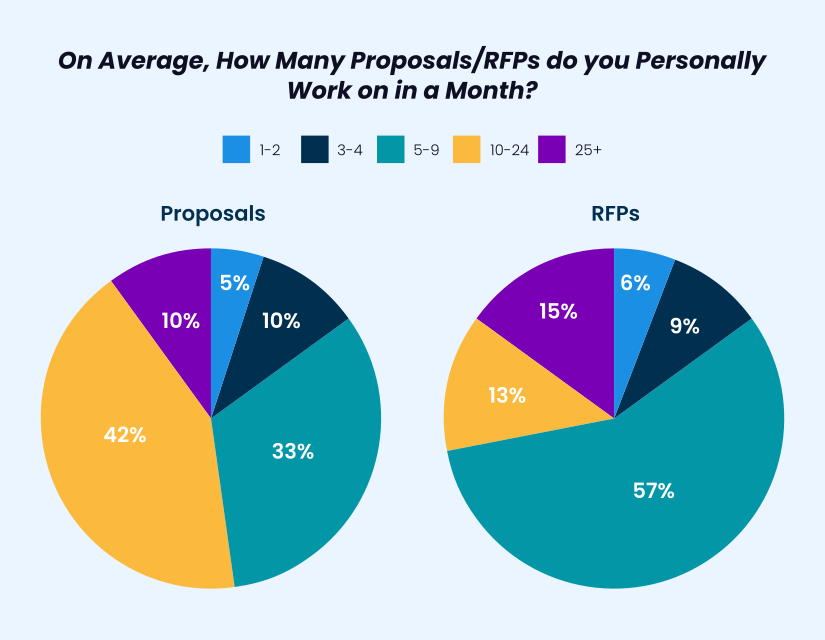
This work is collaborative, and it is getting heavier. The QorusDocs benchmark study shows that law firm proposal teams continue to operate at one of the highest sustained proposal volumes of any industry. More than half of legal respondents (54%) report handling 10 or more proactive proposals per month, while 85% manage at least five RFPs monthly, including 15% handling 25 or more.
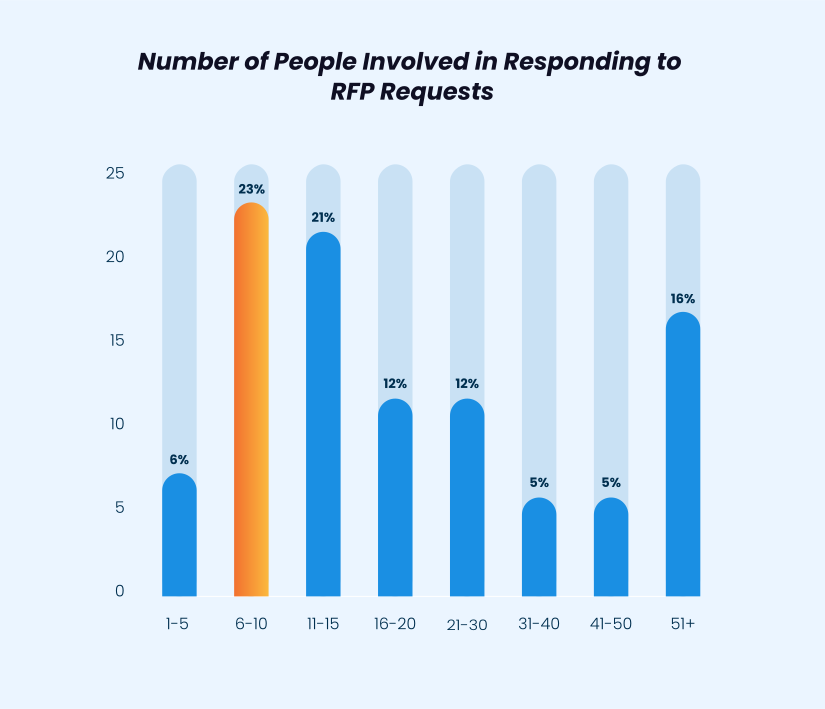
Legal services organizations tend to rely on large, distributed response teams. Only 6% involve five or fewer people in RFP responses. A majority (56%) involve 11 or more contributors, and 38% report teams of 21 or more. Notably, 16% of legal organizations regularly involve 50+ people in responses.
That is the reality proposal teams are working in. They are handling higher volume, more contributors, more scrutiny, and higher expectations. Faster answer generation helps. It does not solve the whole problem.
When we talk to teams in legal, AEC, consulting, and technology services, the pain is rarely “we need more words.” It is usually, “we need the right content, from the right people, in the right format, with enough time left to make it great by personalizing it.”
Teams need a way to manage approved content, involve SMEs, maintain version control, apply brand standards, support legal or industry-specific workflows, and produce the final document without rebuilding it by hand.
What Governed Proposal Management Actually Means
Governed proposal management is not about adding process for the sake of it. It is about making the work safer, faster, and easier to trust.
That distinction matters. Proposal teams do not need another place to store content or another workflow to babysit. They need approved content that is easy to find, AI that works from trusted sources, SME review that does not disappear into email, and templates that keep formatting and brand standards from becoming a last-minute cleanup job.
QorusDocs is one example of this approach. With QPilot Agents, governed content libraries, Microsoft 365-based proposal creation, SME collaboration workflows, and polished Word and PowerPoint output, teams can use AI inside the proposal process rather than bolting it on from the outside.
For legal, AEC, professional services, and technology services teams, the goal extends well beyond faster answers. They need better proposals, stronger pitches, credible business cases, and client-ready documents that help them win.
QorusDocs also supports value and ROI conversations, helping teams connect the “why us” message to the buyer’s “why buy” decision. That is useful when a proposal needs to help the buyer justify action, rather than simply describe capabilities.
AI-Native RFP Response Tools Have a Place. Just Know the Limits.
AI-native RFP tools are a strong fit for fast answer generation on structured questionnaires, but complex, client-facing proposals need more than a fast draft. AI-native RFP response tools can be a smart fit for teams that mainly need fast answer generation, lightweight setup, and support for structured questionnaires.
For complex proposal work, buyers should look closely at what happens after the first draft. Can the tool manage approved content? Support SME review? Handle bios, experience, case studies, project history, and industry-specific language? Produce polished Word and PowerPoint output? Carry the business case through the document?
Those questions separate answer generation from proposal management.
For teams in legal, AEC, professional services, and technology services, the strongest proposal is not always the one drafted fastest. It is the one that is accurate, governed, well-structured, client-specific, and ready to send.
For a deeper breakdown of how AI-native RFP response tools compare with broader proposal management platforms, download our complete guide to proposal management software.
Want a Clearer Way to Compare Proposal Management Options?
Download The Complete Guide to Proposal Management Software for a practical breakdown of AI-native RFP response tools, response management platforms, sales proposal builders, and full proposal management solutions. See where each category fits, what to watch for, and how to choose the right platform for your team.
If your team is still thinking about AI primarily as a faster writing tool, it may be time to think bigger. Talk to us and let us walk you through a demo to see what’s possible.