
How Law Firms Can Improve the Pitch Process and Win More Repeat Business
Recently, I was honored to present Winning AI Essentials at APMP on a topic I spend a lot of time thinking about: where AI can genuinely help proposal teams, and where human judgment still needs to lead.
In my role at QorusDocs, I manage the bid process and respond to RFPs and RFIs. I also help teams make practical use of AI in proposal work. One thing has become clear from doing this work myself: proposal teams don’t need to reinvent their entire process to start reaping value from AI.
One of the biggest mistakes I see is when teams treat AI adoption as a transformation program before they have even proved that one workflow works.
Think about your last bid. How much time went toward work that was necessary, but that no one would call strategic? Copying information. Reformatting. Hunting for the last approved answer. Chasing somebody for information you were fairly sure already existed somewhere. A lot of that work is well suited for AI. The better place to start is small.
Where AI Creates More Time for Strategy
Before GenAI, a huge amount of time could disappear into assembling a draft: finding content, copying it, reformatting it and tailoring it manually. Today, far less of my time goes into assembly. More goes into planning and strategy, reviewing and refining, and directing AI.
This is probably the biggest change I’ve noticed in my own work. The work hasn’t disappeared, rather the hours have moved.
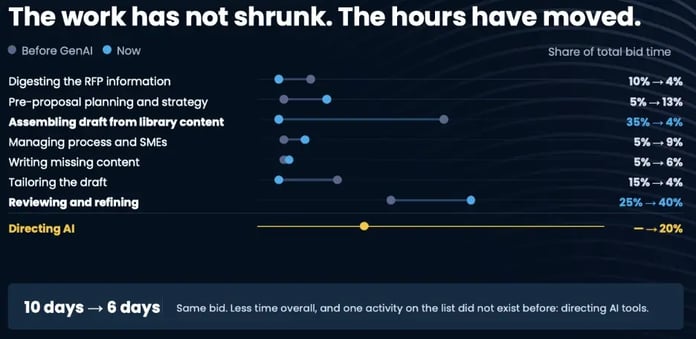
The above figures are not a vendor benchmark and they’re definitely not meant to be scientifically representative of every proposal team. They’re simply an honest view of how my own time has changed.
That’s why I don’t think the proposal role is disappearing. It’s moving up the value chain. Proposal professionals already know how to judge whether an answer missed an evaluation criterion, whether the evidence is weak, or whether something is technically correct but irrelevant to the buyer.
AI makes that judgment more important.
So where should teams begin? I use three filters:
- Is the work predictable and repeatable?
- Can I hand it off and come back when it is ready for review?
- And what happens if it is wrong?
-
Use AI to Structure the Go/No-Go Decision
Bid or no-bid is a good AI proposal workflow because the inputs and outputs are often structured. AI can screen an opportunity against documented criteria, explain its recommendation, flag what the team needs to discuss and assemble a short pursuit brief. But AI structures the go/no-go call. It doesn’t make it.
The real value is getting to the useful part of the meeting sooner. Instead of re-establishing facts, the team can spend time asking:
- Should we bid?
- What are we worried about?
- What would have to be true for us to win?
There is one prerequisite. Your bid criteria need to be written down. If the rules live in three people’s heads, AI may fill the gaps and produce a confident recommendation against criteria it invented. The governance work has value before the AI ever arrives.
-
Build First Drafts from Approved Content
My rule for AI-generated proposal content is simple: draft from approved content wherever possible, rather than asking a general model what it knows about your company. A first draft can know what is in your approved library and what the RFP asks. But it cannot know the steer the BD lead gave you last week, the pricing decision made yesterday, or what the client said in a meeting that never made it into the CRM. The human still owns the argument and the accuracy of anything stated as fact.
Direction matters too. “Draft an answer to the integration requirement” will usually produce generic prose. Give AI the requirement, client, approved source constraint, client environment and what the evaluator is scoring, and the output becomes much more useful.
Smooth prose is not the test. Approved, traceable and true is. I will take an honest gap over a polished invention every single time.
-
Adapt Approved Content to The Client
Most proposal teams already have library content written to work reasonably well for many buyers. The problem is that buyers don’t score us on whether an answer works for everyone. They score the answer in front of them.
AI can help reshape an approved answer around the client’s vocabulary, priorities and evaluation criteria without changing the underlying claim.
If “migration risk” appears repeatedly in the RFP, AI can surface that pattern and help adapt the response. But client relevance still belongs to the proposal team. AI can tell us what appears in the documents. We still decide what matters and what should lead the answer.
-
Make SME Review Smaller and More Precise
This is one of my favorite AI proposal workflows because it solves a problem almost every proposal team has.
When we say, “We need SME review,” there are often two reviews hiding inside that sentence. One is verification: Is the claim sourced? Does the source support it? Much of that can be handled before the SME sees the section.
The second is fit: Is this the right approach for this client, in their environment and with their constraints? That is where I want the SME. Instead of sending someone a 12-page section and asking them to “review,” AI can help prepare a short brief and a handful of targeted questions. Ask for the decision, not the prose. SMEs are not there to write the proposal.
Five questions and 15 minutes is a much easier request than “Can you review the technical section?”
-
Use AI for Quality Checks, Not Final Sign-Off
Quality checking is another strong AI proposal workflow. Objective checks are the safest to hand over: Did we answer every requirement? Are we within the word limit? Are names and numbers consistent?
Then there are judgment checks. Does the answer address the question? Are there unsupported claims? Do sections contradict each other?
Here, I want AI to surface candidates, not make the decision. I ask for findings, not rewrites: location, issue and severity. AI can help check compliance, but it cannot confirm compliance. The sign-off stays human.
Start Small, Then Earn the Next Step
Across all five AI proposal workflows, there are four things I believe AI never owns: strategy, compliance, accuracy and client relevance. It can support all four, but the accountability stays with us.
My rule for moving toward more delegated or automated work is simple: only move up the ladder when the rung below has become boring. If basic AI use is still surprising you every day, you probably do not need full automation yet.
Three practical guardrails cover a surprising amount of the risk: use approved, permissioned content as the source; put a named human gate before anything reaches the client; and write down what you tried so the team learns from what worked and what did not.
AI amplifies whatever state your inputs are already in. If your criteria are undocumented and your content library is outdated, AI will help you act on those weaknesses faster. With documented criteria, governed content and clear review gates, it can work from evidence you can stand behind.
So, my challenge is deliberately small: pick one workflow and run it against a bid you have already submitted, where you already know what a good answer looks like. Write down what happened. You do not need an AI transformation program to start learning. You need one useful experiment.
You can watch the full video here.
Ready to Put AI to Work in Your Proposal Process?
You don’t need to overhaul your proposal process to start getting value from AI. See how QorusDocs can help your team automate repetitive work, work from trusted content and create more room for the judgment and strategy that win bids. Book a demo.